
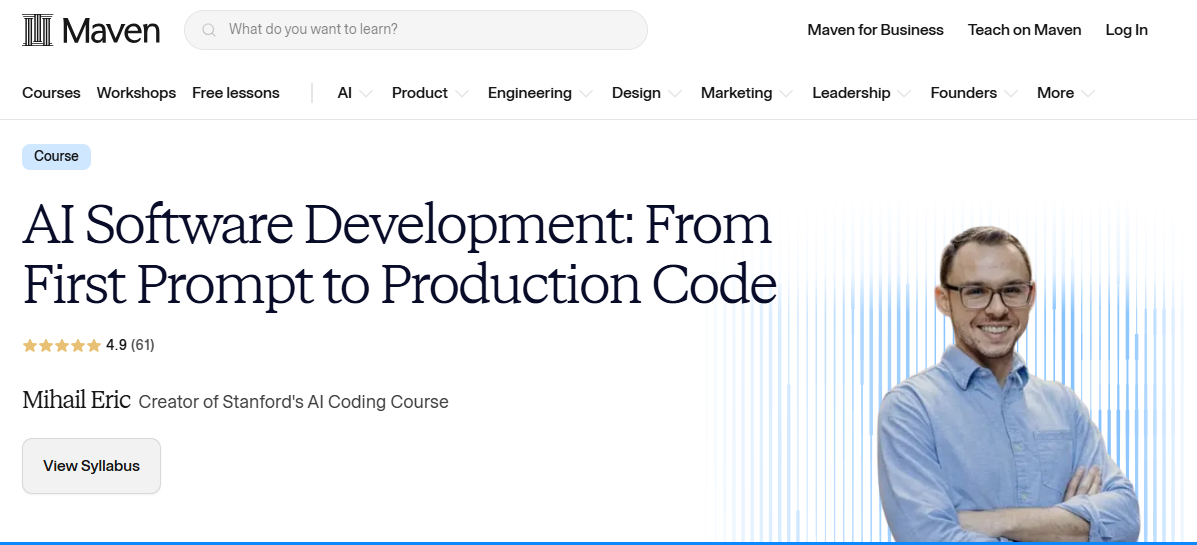
Mihail Eric – AI Software Development (July 2026)
$297.00 Original price was: $297.00.$35.00Current price is: $35.00.
- 24/7 Contact Support & Telegram - Ecomkevin_1
- You Can Request Any Courses
- Original Courses HD Qualite and links updated
Guaranteed Safe Checkout


Mihail Eric – AI Software Development: A Complete Guide for Modern AI Engineers
Artificial intelligence is transforming how software is designed, developed, tested, and deployed. As organizations increasingly integrate AI into products and services, developers need practical skills that go beyond traditional programming. Mihail Eric – AI Software Development focuses on helping software engineers understand modern AI development workflows, engineering best practices, and production-ready implementation techniques.
Rather than treating AI as a collection of isolated machine learning models, this learning experience emphasizes building reliable, scalable, and maintainable AI-powered software systems. Developers gain insight into integrating large language models, automation frameworks, APIs, cloud infrastructure, and software engineering principles into real-world applications.
Whether you’re a software engineer looking to enter AI development or an experienced programmer wanting to modernize your skills, understanding AI software engineering principles can significantly improve your ability to build intelligent applications.
Why AI Software Development Matters
The software industry has evolved rapidly over the past few years. Traditional application development is now being combined with:
- Large Language Models (LLMs)
- AI-assisted coding
- Intelligent automation
- Retrieval-Augmented Generation (RAG)
- Vector databases
- AI agents
- Prompt engineering
- Cloud-based AI services
Modern developers are expected to understand not only programming languages but also how AI models integrate into production systems.
Learning these concepts helps developers create applications that are more intelligent, efficient, and capable of solving complex business problems.
What Is Mihail Eric – AI Software Development?
Mihail Eric – AI Software Development introduces practical methods for designing, developing, testing, and deploying AI-powered applications using modern engineering workflows.
Instead of focusing only on theory, the material explores how developers can build production-grade AI systems using proven software engineering principles.
Core topics generally include:
- AI application architecture
- Machine learning integration
- API development
- LLM implementation
- Model deployment
- Backend engineering
- Cloud infrastructure
- Performance optimization
- Security considerations
- Development workflows
The emphasis remains on practical implementation rather than purely academic concepts.
Who Should Learn AI Software Development?
This learning resource is suitable for many different technical professionals.
Software Engineers
Developers wanting to transition into AI engineering can understand how modern AI systems are built.
Backend Developers
Backend engineers can learn how to integrate AI APIs into scalable services.
Full-Stack Developers
Frontend and backend developers benefit from understanding complete AI application architecture.
Startup Founders
Technical entrepreneurs can better understand how AI products are designed and launched.
Product Engineers
Teams building AI-powered SaaS products can learn best practices for scalable implementation.
Students
Computer science students gain practical exposure beyond traditional coursework.
Essential Skills Covered
A modern AI software engineer needs expertise across multiple domains.
AI Fundamentals
Understanding how AI models work creates a strong technical foundation before implementation.
Topics include:
- Neural networks
- Transformers
- Language models
- Model inference
- Embeddings
- Tokenization
Prompt Engineering
Effective prompts significantly improve AI application performance.
Developers learn how prompts influence outputs while designing reliable workflows for production systems.
API Integration
Most AI applications rely on external APIs.
Developers learn how to:
- Send requests
- Handle responses
- Manage authentication
- Optimize performance
- Reduce latency
Backend Development
AI software depends on strong backend architecture.
Key concepts include:
- REST APIs
- Authentication
- Databases
- Caching
- Background processing
- Task queues
Cloud Deployment
Modern AI applications rarely run only on local machines.
Understanding deployment helps developers create scalable systems using cloud infrastructure.
AI Automation
Automation reduces repetitive tasks while increasing productivity.
Examples include:
- Document processing
- Customer support
- Workflow automation
- Data extraction
- Report generation
Building Production AI Applications
Many developers successfully build AI prototypes but struggle when deploying them in production.
Production-ready systems require attention to:
- Reliability
- Monitoring
- Error handling
- Logging
- Security
- Scalability
- Testing
Learning production engineering principles is one of the biggest advantages of structured AI development education.
Real-World Applications
AI software development extends across numerous industries.
Healthcare
AI assists with:
- Medical documentation
- Image analysis
- Clinical workflows
- Patient support
Finance
Financial organizations use AI for:
- Fraud detection
- Risk assessment
- Customer service
- Document analysis
E-Commerce
Retail businesses implement AI for:
- Product recommendations
- Personalized search
- Customer support
- Inventory forecasting
Marketing
Marketing teams automate:
- Content generation
- Campaign analysis
- Customer segmentation
- Email personalization
Education
Educational platforms use AI for:
- Personalized tutoring
- Learning recommendations
- Assessment support
- Knowledge retrieval
Modern AI Development Workflow
Professional AI engineering generally follows a structured workflow.
Problem Definition
Clearly identify the business objective before selecting AI tools.
Data Preparation
Collect, organize, and validate relevant data sources.
Model Selection
Choose an appropriate AI model based on project requirements.
Development
Integrate AI functionality into the application architecture.
Testing
Validate outputs using automated and manual testing methods.
Deployment
Release applications using scalable infrastructure.
Monitoring
Track performance and continuously improve results.
Best Practices for AI Software Engineering
Successful AI applications share several characteristics.
Modular Design
Separate AI components from business logic for easier maintenance.
Documentation
Maintain clear documentation for APIs, prompts, workflows, and architecture.
Security
Protect user information and secure AI endpoints.
Continuous Improvement
Monitor outputs and refine prompts, workflows, and system performance over time.
Scalability
Design systems capable of handling increased workloads without sacrificing reliability.
Common Challenges
Developers entering AI engineering often encounter several obstacles.
Hallucinations
AI models occasionally generate inaccurate responses.
Latency
Large models can introduce slower response times.
Cost Management
API usage should be monitored to optimize expenses.
Data Privacy
Applications must handle sensitive information responsibly.
Model Updates
Rapid improvements in AI require ongoing learning and adaptation.
Understanding these challenges helps developers build more reliable applications.
Benefits of Learning AI Software Development
Developers who understand AI engineering gain several advantages.
- Stronger technical portfolio
- Increased career opportunities
- Better understanding of AI architecture
- Ability to build intelligent applications
- Improved productivity
- Experience with modern development tools
- Enhanced problem-solving capabilities
- Readiness for emerging AI technologies
Practical Projects to Build
Applying knowledge through projects accelerates learning.
Examples include:
- AI chatbot
- Document summarizer
- Code assistant
- Knowledge base search tool
- AI writing assistant
- Customer support automation
- Meeting notes generator
- Internal company assistant
- Recommendation engine
- AI-powered analytics dashboard
Building projects demonstrates practical skills and strengthens a developer’s portfolio.
Career Opportunities
Organizations across industries continue investing in AI solutions, creating demand for professionals with software engineering and AI expertise.
Potential career paths include:
- AI Software Engineer
- Machine Learning Engineer
- Backend AI Developer
- AI Solutions Architect
- Full-Stack AI Engineer
- MLOps Engineer
- AI Product Engineer
- Intelligent Automation Developer
Professionals who combine strong programming skills with AI implementation experience are well positioned for long-term career growth.
Final Thoughts
Mihail Eric – AI Software Development represents the growing intersection of traditional software engineering and artificial intelligence. As AI becomes an essential component of modern applications, developers who understand both engineering fundamentals and AI integration techniques will be increasingly valuable.
Learning how to build secure, scalable, and maintainable AI-powered software enables developers to solve real business challenges while preparing for the future of technology. By focusing on practical implementation, architectural best practices, and production-ready workflows, aspiring AI engineers can develop the confidence needed to create intelligent applications that deliver measurable value.
