
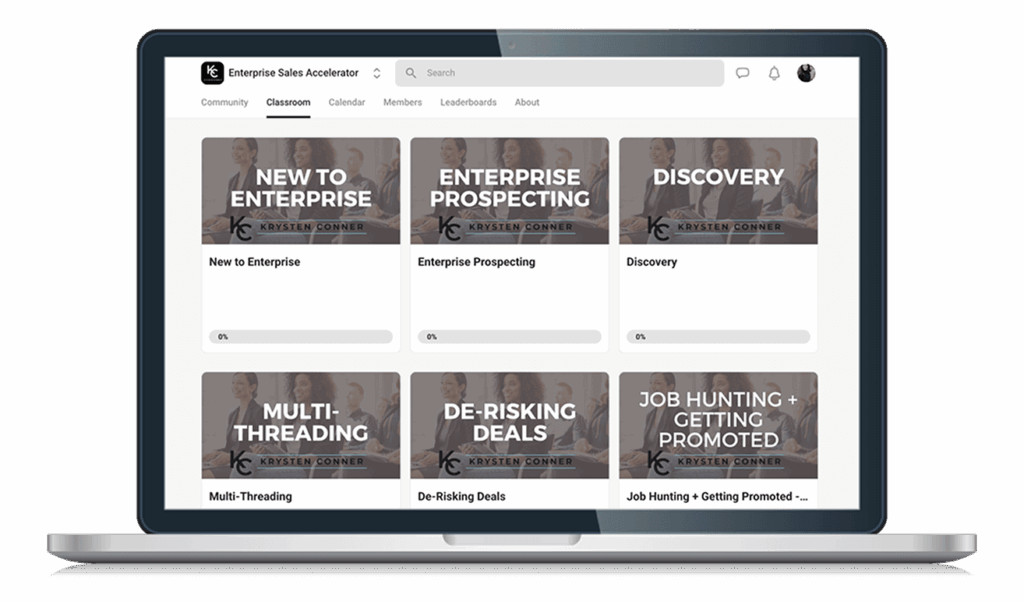
Krysten Conner – Enterprise Sales Accelerator
$699.00 Original price was: $699.00.$75.00Current price is: $75.00.
- 24/7 Contact Support & Telegram - Ecomkevin_1
- You Can Request Any Courses
- Original Courses HD Qualite and links updated
Guaranteed Safe Checkout


Krysten Conner – Enterprise Sales Accelerator Review
Selling to large organizations is very different from selling to small businesses or individual consumers. Enterprise buyers often involve multiple decision-makers, longer sales cycles, larger contract values, and more complex negotiations. Because of these challenges, sales professionals are constantly searching for proven systems that can help them improve their closing rates and confidently manage high-value opportunities.
Krysten Conner – Enterprise Sales Accelerator is designed to help professionals understand the principles behind enterprise-level selling. Instead of relying on outdated scripts or aggressive sales tactics, the program focuses on building long-term relationships, creating value-driven conversations, and developing repeatable sales processes that can be applied across different industries.
This review explores what the program offers, who it is designed for, its potential advantages, and why enterprise selling remains one of the most valuable skills in today’s competitive business environment.
What Is This Program?
This training focuses on the modern enterprise sales process. It introduces strategies that can help professionals understand buyer psychology, navigate complex organizations, qualify opportunities, communicate value effectively, and manage lengthy sales cycles.
Rather than promoting shortcuts, the course emphasizes developing structured systems that improve consistency and confidence during every stage of the sales journey.
The material is presented in a practical way, making it easier for learners to understand concepts that can often seem overwhelming when first entering enterprise sales.
Why Enterprise Sales Skills Matter
Enterprise selling continues to evolve as companies become more informed before speaking with sales representatives. Buyers conduct extensive research, compare multiple vendors, and expect personalized solutions.
Strong enterprise sales skills can help professionals:
- Build trust with executive stakeholders
- Understand organizational buying processes
- Improve communication with decision-makers
- Navigate procurement requirements
- Handle complex negotiations professionally
- Increase long-term client relationships
- Improve forecasting accuracy
- Create scalable sales systems
Learning these skills can benefit both experienced professionals and those transitioning into higher-value B2B sales environments.
Core Topics Covered
Although individual learning experiences may vary, the training generally focuses on major areas commonly associated with enterprise selling.
Understanding Enterprise Buyers
Enterprise customers usually involve multiple departments before making purchasing decisions. Learning how different stakeholders evaluate solutions can improve communication and positioning.
Topics may include:
- Executive priorities
- Financial decision-making
- Technical evaluations
- Procurement requirements
- Internal approval processes
- Buying committees
- Organizational structures
Building a Structured Sales Process
Successful enterprise sales rarely happen through improvisation.
Instead, professionals often benefit from structured systems that include:
- Prospect research
- Discovery conversations
- Qualification frameworks
- Solution positioning
- Objection handling
- Proposal development
- Negotiation preparation
- Closing strategies
- Account expansion
A repeatable process helps reduce uncertainty while improving consistency.
Discovery Conversations
One of the most valuable enterprise sales skills involves asking better questions.
Effective discovery meetings focus on understanding:
- Business challenges
- Operational goals
- Existing workflows
- Decision timelines
- Budget considerations
- Success metrics
- Internal obstacles
- Desired outcomes
Strong discovery conversations often lead to more meaningful proposals.
Value-Based Selling
Rather than competing only on price, enterprise sales professionals often focus on business outcomes.
Potential areas include:
- Return on investment
- Productivity improvements
- Cost reduction
- Revenue growth
- Risk management
- Process optimization
- Operational efficiency
- Strategic alignment
Value-focused discussions typically resonate more with executive decision-makers.
Sales Communication Strategies
Communication remains one of the most important enterprise selling skills.
The program discusses methods for improving:
- Business conversations
- Executive presentations
- Sales meetings
- Follow-up communication
- Stakeholder engagement
- Objection responses
- Proposal discussions
- Relationship development
Professional communication builds credibility throughout the buying process.
Managing Long Sales Cycles
Enterprise opportunities often take weeks or months before reaching a final decision.
Maintaining momentum requires:
- Regular follow-ups
- Stakeholder mapping
- Meeting preparation
- Progress tracking
- Pipeline management
- Consistent relationship building
- Strategic planning
Understanding these stages helps reduce stalled opportunities.
Negotiation Techniques
Negotiation is rarely about lowering prices.
Instead, effective enterprise negotiations often involve:
- Business value
- Contract structure
- Implementation planning
- Success metrics
- Partnership expectations
- Risk reduction
- Timeline management
Preparation plays a significant role in successful negotiations.
Building Long-Term Client Relationships
Winning a contract represents only the beginning of a successful enterprise partnership.
Long-term relationship strategies may include:
- Customer success planning
- Regular business reviews
- Performance tracking
- Strategic recommendations
- Expansion opportunities
- Cross-functional communication
- Trust building
Satisfied enterprise clients often generate referrals and additional opportunities.
Skills That Can Be Improved
Many professionals seek training to strengthen practical business skills.
Potential learning outcomes include:
- Better sales organization
- Improved confidence
- Stronger presentations
- Enhanced listening skills
- Better qualification techniques
- Effective stakeholder management
- Improved negotiation preparation
- Professional account management
- Strategic communication
These transferable skills remain valuable across many industries.
Who May Benefit From This Training?
This type of program may be suitable for:
B2B Sales Representatives
Professionals selling software, services, consulting, or business solutions.
Account Executives
Individuals managing larger customer relationships.
Sales Managers
Leaders looking to improve team performance and create repeatable sales systems.
Business Development Professionals
Individuals responsible for generating enterprise opportunities.
Consultants
Professionals selling advisory services to larger organizations.
Entrepreneurs
Founders building B2B businesses with larger client contracts.
Potential Benefits
Participants may appreciate several aspects of enterprise sales education.
Possible advantages include:
- Structured learning approach
- Practical sales frameworks
- Better organization
- Professional communication methods
- Improved pipeline management
- Stronger client relationships
- Better understanding of enterprise buyers
- More strategic sales planning
- Increased confidence during meetings
Learning outcomes ultimately depend on individual effort, prior experience, and consistent application.
Modern Enterprise Selling
Today’s buyers expect sales professionals to provide insights instead of simply promoting products.
Modern enterprise selling emphasizes:
- Customer education
- Business consulting
- Strategic conversations
- Problem solving
- Long-term partnerships
- Collaborative planning
- Personalized recommendations
Organizations increasingly value trusted advisors rather than traditional salespeople.
Building a Repeatable Sales System
Consistency often separates top-performing sales professionals from average performers.
Developing repeatable habits can include:
- Daily prospecting
- CRM organization
- Account research
- Meeting preparation
- Proposal templates
- Follow-up schedules
- Opportunity reviews
- Performance analysis
Small improvements performed consistently often produce meaningful long-term results.
Things to Consider Before Enrolling
Before investing in any professional training, consider several factors.
Think about:
- Your current sales experience
- Career goals
- Industry requirements
- Available study time
- Learning preferences
- Ability to apply concepts consistently
Education delivers the greatest value when combined with practical implementation.
Pros
- Organized learning structure
- Focus on enterprise sales principles
- Practical communication strategies
- Emphasis on relationship building
- Covers multiple stages of the sales cycle
- Suitable for various experience levels
- Encourages systematic selling
- Applicable across many B2B industries
Cons
- Results depend on consistent practice.
- Enterprise sales generally require patience because sales cycles can be lengthy.
- Some concepts may already be familiar to experienced professionals.
- Practical implementation is essential for long-term improvement.
Final Verdict
For professionals interested in improving enterprise selling capabilities, this program provides a structured introduction to many of the concepts commonly associated with complex B2B sales. From understanding buyer behavior and conducting stronger discovery conversations to communicating value and managing long sales cycles, the training aims to help learners develop organized, repeatable sales habits.
Rather than promising guaranteed outcomes, the material is best viewed as a professional development resource. Individuals who actively practice the techniques, adapt them to their own industry, and consistently refine their approach are likely to gain the greatest value.
If your goal is to strengthen enterprise sales knowledge, improve client conversations, and build a more systematic selling process, this training may be a worthwhile learning resource to evaluate.
Frequently Asked Questions
Is this training suitable for beginners?
Yes. While enterprise sales can be complex, many of the foundational concepts are presented in a structured manner that beginners can understand.
Can experienced sales professionals benefit?
Experienced professionals may use the material as a way to refine existing processes, improve consistency, and discover additional enterprise sales strategies.
Does enterprise sales require technical knowledge?
Not necessarily. Success often depends more on understanding business problems, communicating value, and managing relationships than on technical expertise alone.
How long does it take to improve enterprise sales skills?
Skill development varies by individual. Consistent practice, real-world application, and continuous learning generally contribute to long-term improvement.
Is this focused only on software sales?
Many enterprise sales principles can be applied across industries, including consulting, professional services, technology, manufacturing, and business solutions.
